
Home saunas are an amazing addition to any home, but what does one cost? Learn…

Sauna Room Size Guide: Finding the Perfect Fit for Your Home [2026 Edition]
Stop second-guessing sauna sizes! Expert breakdown of dimensions, costs, and layouts for every home and budget. Your perfect fit awaits.
YDo you find yourself staring at that empty corner of your basement, wondering if it’s big enough for a sauna? Or maybe sketching out plans for your dream backyard oasis, tape measure in hand? No matter what step of the planning process you find yourself in, there’s one thing you want to remember: Getting your sauna room size right isn’t just about fitting the thing in your space—it’s about creating a wellness sanctuary that actually works for your family, your budget, and your lifestyle.
There’s no doubt that saunas take up a lot of space in the luxury home market, with home saunas now making up over 70% of market demand. What most people don’t realize, though, is that the actual amount of space they can take up in your home varies widely: a single-person sauna needs as little as 16 square feet (4′ x 4′), while an 8-10 person sauna could demand up to 100 square feet.
In this comprehensive guide, we’ll walk through everything you need to know about sauna sizing so you can get it right when planning for your own. We’ll cover:
• Standard dimensions for every family size, from solo sanctuaries to group gathering spaces
• The critical role of ceiling height (spoiler: 7 feet isn’t just a suggestion)
• How to balance your space constraints with heating efficiency and long-term satisfaction
Whether you’re converting a closet or building from scratch, let’s find the sauna size that’ll have you saying “why didn’t we do this sooner?” instead of “maybe we should have gone bigger.”
Table of Contents
Show
Understanding Your Sauna Space Requirements
You know what’s funny? Most folks approach sauna sizing backwards. They measure their available space, then try to squeeze in the biggest sauna that’ll fit. But that’s like buying shoes based on your closet space rather than your feet.
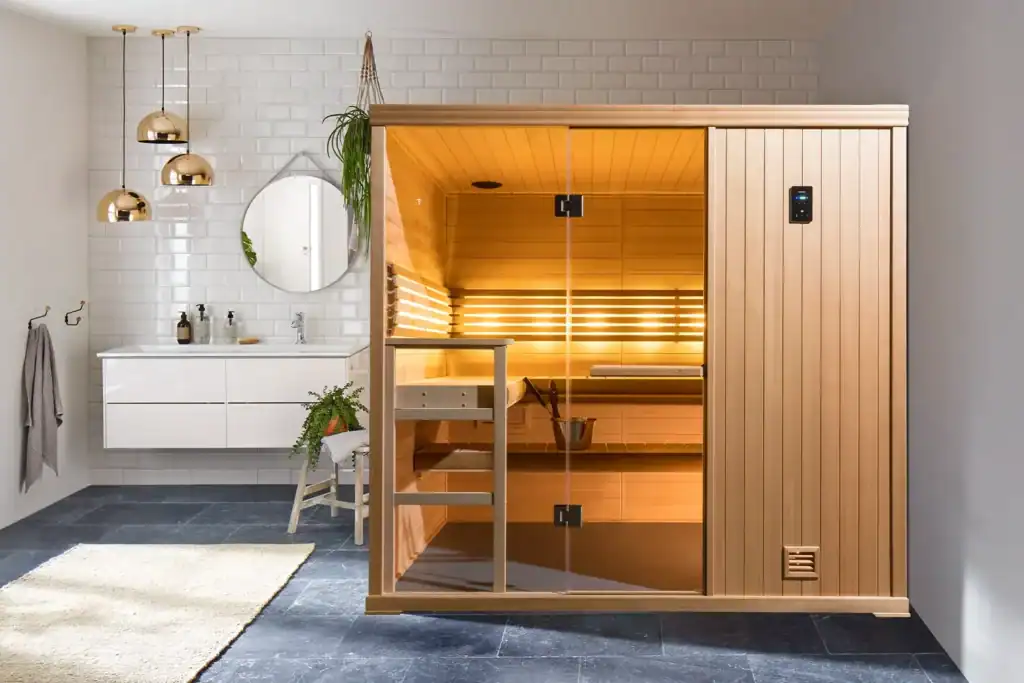
Why Sauna Size Matters More Than You Think
Here’s a rule of thumb that might save you thousands in regret. A sauna that’s too small feels like sitting in a hot phone booth. Too big? You’ll wait forever for it to heat up, and your energy bills will remind you monthly that bigger isn’t always better.
The sweet spot exists, and it’s different for everyone. A family of four doesn’t necessarily need a four-person sauna if two people max will ever use it at once. But if you’re the type who hosts backyard parties, that cozy two-person unit might leave you explaining to friends why they can’t join the sauna train.
Think about your actual usage patterns. When will you use it? Who’ll be joining you? Are you looking for meditation-style solo sessions, or is this going to be social hour central?
Understanding these basics helps you avoid the common pitfalls covered in our guide to home sauna installation mistakes, which often stem from poor initial planning.
Key Factors That Influence Your Sauna Dimensions
Space planning for a sauna isn’t always straightforward. While your available footprint is the obvious starting point, several other details can dramatically affect the size and design of your sauna. Ceiling height, sauna type, and even how you plan to maintain the unit all play a role. Overlooking these considerations can create installation headaches—or worse, long-term usability problems.
Key factors to keep in mind include:
- Ceiling height – Impacts everything from where benches can be installed to how efficiently your sauna heats.
- Type of sauna – Traditional saunas and infrared models have different size requirements and clearances.
- Access points – Make sure sauna panels or kits can fit through your doorways and hallways during delivery and installation.
- Electrical service – Confirm you have the right electrical capacity and outlet location for your chosen sauna type.
- Cleaning and maintenance space – Leave room around and behind your sauna for upkeep. Without it, routine maintenance becomes a nightmare, leading to long-term problems.
Proper planning ensures your sauna isn’t just a perfect fit for your space today—it’s also functional, accessible, and sustainable for years to come.
Here’s another critical consideration – the relationship between room dimensions and required clearances:
| Room Size | Recommended Sauna Size | Clearance Space | Usable Features |
| 8′ × 10′ | 5′ × 7′ | 18″ all sides | Changing area, storage |
| 10′ × 12′ | 6′ × 8′ | 2′ minimum | Full changing room |
| 12′ × 14′ | 8′ × 10′ | 2-3′ optimal | Relaxation seating |
| 14′ × 16′ | 10′ × 12′ | 3′ luxury | Shower, cooling area |
Standard Sauna Dimensions by Capacity
Let’s get into the meat and potatoes. These aren’t just random numbers – they’re based on years of real-world experience and countless customer installations.
Single-Person Saunas (3′ x 3′ to 4′ x 4′)
The solo sauna. Perfect for apartments, small homes, or anyone who views sauna time as sacred and personal. A 3′ x 3′ unit is truly minimal – you’re sitting upright, no lying down, but it works. Most people prefer the 4′ x 4′ option because it gives you room to shift positions.
Honestly, single-person saunas are having a moment. They heat up fast (usually 15-20 minutes), use minimal energy, and fit almost anywhere. I’ve seen them tucked into walk-in closets, spare bathrooms, even converted pantries.
The downside? No sharing the experience, and you can’t stretch out. But if you’re the type who sees sauna time as meditation time, this might be perfect.
Two-Person Saunas (4′ x 5′ to 5′ x 6′)
This is America’s sweetheart of sauna sizes. Big enough for couples, small enough to heat efficiently, and flexible enough to handle solo sessions when you want extra room.
A 4′ x 5′ unit gives you basic two-person seating, while 5′ x 6′ adds some luxury – you can actually lie down if you want. These dimensions work well for most ceiling heights and don’t overwhelm smaller spaces.
Here’s a pro tip: if you’re on the fence between one and two-person capacity, go with two. The extra space makes solo sessions more comfortable, and you’ll appreciate having the option for company.
Family Saunas (6′ x 8′ to 8′ x 10′)
Now we’re talking serious sauna real estate. These sizes accommodate 4-6 people comfortably, with room for different seating arrangements. You can do L-shaped benches, opposing benches, even tiered seating like a mini amphitheater.
A 6′ x 8′ sauna hits that sweet spot for many families. Four adults can sit comfortably, or two adults and several kids. The 8′ x 10′ version is where you start getting into luxury territory – multiple bench levels, space to move around, room for accessories like backrests or cup holders.
The trade-off? Heating time jumps to 30-45 minutes, and you’ll need a more powerful heater. Your electrical requirements go up too.
Large Group Saunas (8′ x 12′ and Beyond)
These are the show-stoppers. Eight to twelve people, multiple bench configurations, and enough space to actually socialize. But let’s be real – do you need this much sauna?
Large group saunas make sense for specific situations. Maybe you live on a lake and host summer gatherings. Perhaps you’re building a rental property or multi-generational home. Or you just really, really love entertaining. The benefits of barrel sauna designs become particularly relevant at this scale, as they can efficiently accommodate large groups while using space effectively.
The costs scale up significantly. You’re looking at commercial-grade heaters, substantial electrical work, and heating times that can stretch to an hour. But man, when you fire up an 8′ x 12′ sauna filled with friends and family, it’s pretty magical.
The Critical Role of Sauna Height in Your Design
Here’s where a lot of DIY projects go wrong. People obsess over length and width, then treat height like an afterthought. Big mistake.
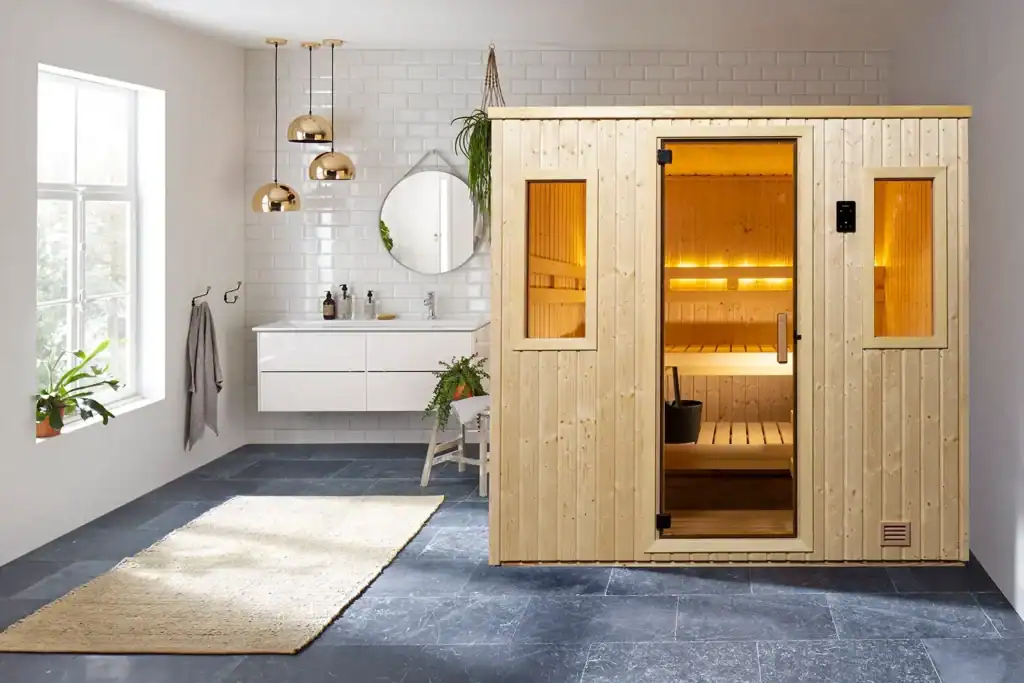
Why 7 Feet is the Sweet Spot for Ceiling Height
Research shows that residential sauna height is ideally 6.5-7 feet for optimal heat distribution and headroom. Any taller, and you’re fighting physics. Heat rises, so those extra inches above 7 feet just create dead space that your heater has to work harder to fill.
But there’s more to it. The height determines your bench placement, which affects your entire sauna experience. You want to sit with the hottest air at chest and head level, not floating uselessly above you.
Think of it like this: every inch above 7 feet is money you’re spending to heat air you’ll never use. Plus, higher ceilings mean more materials, more insulation, and more complexity.
Working Around Non-Standard Ceiling Heights
Not everyone gets to build from scratch. Maybe your basement has 8-foot ceilings, or you’re dealing with a sloped roof line. Don’t panic – you’ve got options.
For ceilings above 8 feet, consider a drop ceiling inside the sauna. You maintain the exterior aesthetics while creating the perfect interior height. For lower ceilings (6 feet or less), you might need to adjust your bench heights or consider infrared options that don’t rely on traditional heat circulation.
I’ve seen creative solutions work beautifully. One customer built a raised floor to bring the effective ceiling height down. Another used the extra height above 7 feet for storage – sauna towels, essential oils—that sort of thing.
Sauna Bench Layouts: Maximizing Comfort and Space
The bench layout makes or breaks your sauna experience. You can have the perfect dimensions, but if the seating doesn’t work, the whole thing fails.
Single-Tier Bench Configurations
Simple and effective. One bench level, usually 18-20 inches high, running along one or more walls. This works great for smaller saunas where you want to maximize floor space.
Single-tier layouts are easier to build, easier to clean, and more accessible for people with mobility concerns. You sacrifice some of that traditional sauna hierarchy (where higher benches are hotter), but you gain simplicity.
These configurations shine in infrared saunas, where the heating is more even and you don’t need the temperature gradients of traditional saunas.
Double-Tier Bench Systems
This is the classic sauna setup. Lower bench at about 16-18 inches, upper bench at 32-36 inches. The temperature difference between levels can be 15-20 degrees, giving users options.
Double-tier systems require more ceiling height and careful planning. You want enough headroom on the upper bench (at least 40 inches to the ceiling), plus space to move between levels safely.
The lower bench often slides under the upper one for cleaning and to create standing space. It’s a clever design that’s been refined over generations of sauna building.
L-Shaped and Corner Bench Designs
For larger saunas, L-shaped benches maximize seating while maintaining intimacy. Instead of everyone sitting in a row like they’re waiting for a bus, people can face each other and actually converse.
Corner configurations work especially well in square or nearly square saunas. You can fit more people in the same footprint, and the layout feels more social and welcoming.
The downside? Corners can be harder to clean, and you need to think carefully about heater placement to ensure even heating throughout the space.
Infrared vs Traditional Saunas: Size Considerations
Not all saunas are created equal, and the type you choose dramatically affects your size requirements.
Compact Infrared Sauna Advantages
Infrared saunas now command 45%+ of the home market, and at least part of that demand is thanks to their size-flexibility. After all, no steam means no ventilation requirements, and no massive heater means more usable space.
A 3′ x 4′ infrared sauna can be genuinely comfortable because the heating is direct and even. You’re not relying on air circulation, so tight spaces work just fine. Plus, they heat up in 15 minutes instead of 30-45. To understand the full differences, check out our detailed comparison of infrared vs traditional sauna pros and cons.
The compact nature makes them perfect for indoor installations where space is premium. I’ve seen infrared saunas in master bedrooms, home offices, even large walk-in closets.
Traditional Steam Sauna Space Requirements
Traditional saunas need room to breathe, literally. You need ventilation, space around the heater, and enough volume for proper air circulation. This usually means larger minimum dimensions.
A traditional sauna under 4′ x 5′ starts feeling cramped because you need clearance around the heater and proper air flow patterns. The steam and higher humidity also mean you want more space between users.
But traditional saunas offer that authentic experience that so many sauna-lovers are after. The ritual of löyly (throwing water on the rocks), the temperature gradients, the social aspect – it requires space, but it’s worth it for purists.
Heating Your Sauna: Size-to-Power Ratios
If you want to be sure you’re heating your sauna as quickly and efficiently as possible, you’ll want to consider how size comes into play here too.
Calculating Cubic Feet for Proper Heater Sizing
The formula is simple: Length × width × height gives you cubic feet. Most heaters are rated for specific cubic foot ranges, and you want to be in the sweet spot, not the extremes.
A 6′ × 8′ × 7′ sauna has 336 cubic feet. Check your heater specifications – you want one rated for 300-400 cubic feet, not one that maxes out at 350 or starts at 400.
Energy Efficiency Based on Room Dimensions
Smaller saunas are inherently more efficient, but not always more economical. A tiny sauna that runs constantly because it can’t hold heat wastes more energy than a properly sized unit that maintains temperature easily.
The cube-square law applies here. As your sauna gets bigger, volume increases faster than surface area. This means larger saunas can be more efficient per person, even though they use more total energy.
Think long-term. A slightly larger sauna that accommodates your whole family might use more power per session but fewer total sessions than a smaller unit that forces people to take turns. For detailed breakdowns of operating costs, our guide on how much electricity does a sauna use provides specific numbers by sauna size.
| Sauna Size | Cubic Feet | Recommended Heater | Heat-Up Time | Energy Per Session |
| 3′ × 3′ × 7′ | 63 | 2-3 kW | 15-20 min | 1-1.5 kWh |
| 4′ × 5′ × 7′ | 140 | 4-5 kW | 25-30 min | 2-2.5 kWh |
| 6′ × 8′ × 7′ | 336 | 6-8 kW | 30-40 min | 3-4 kWh |
| 8′ × 10′ × 7′ | 560 | 9-12 kW | 40-50 min | 5-6 kWh |
Location-Specific Sizing Strategies
The choice between indoor vs outdoor saunas significantly impacts your sizing options and constraints.
Indoor Sauna Space Planning
Indoor saunas benefit from being protected from weather and integrated into your living space, but they’re restricted by your home’s current layout. You’ll need to plan carefully around ceiling height, electrical access, and ventilation.
- Structural constraints: Ceiling height is usually fixed, and you must adapt to your home’s existing walls and layout.
- Utilities: Existing electrical and ventilation systems must be considered, with modifications often required.
- Popular locations:
- Basements work well since ceiling height is less critical and new electrical can be added more easily.
- Spare bedrooms can be converted if ceiling height is sufficient and you have a plan for moisture management.
- Basements work well since ceiling height is less critical and new electrical can be added more easily.
Practical tip: A 6′ × 6′ room might seem limiting, but you can fit a 5′ × 5′ sauna inside while leaving perimeter space for maintenance access.
Outdoor Sauna Footprint Considerations
Building an outdoor sauna offers nearly unlimited sizing flexibility, but it introduces other factors that can affect cost and feasibility. Foundations, weatherproofing, and property regulations must all be accounted for before breaking ground.
- Design freedom: You can choose almost any size or shape since you’re not confined by existing walls.
- Foundations & protection: Requires site preparation, weatherproofing, and in many cases, a concrete pad or structural base.
- Code compliance: Local setback rules may require specific distances from property lines, septic systems, or other buildings.
- Site preparation costs:
- Small sauna on a simple pad: around $500.
- Large sauna needing concrete, trenching, and site clearing: $5,000+ before construction begins.
- Small sauna on a simple pad: around $500.
Converting Existing Spaces into Saunas
Converting existing spaces requires compromise and creativity. That 5′ × 8′ spare bathroom isn’t ideal sauna dimensions, but it could work with the right approach.
Consider partial conversions. Maybe you don’t need the whole room – a 4′ × 6′ sauna in one corner leaves space for storage or changing area. Creative layouts can make odd-shaped spaces work beautifully. Our comprehensive home sauna installation guide covers the specifics of working with existing spaces.
Ventilation and Safety Requirements by Size
Bigger saunas need more air movement, but it’s not a simple linear relationship.
Air Circulation Standards for Different Sauna Volumes
A good rule of thumb: you want 6-8 air changes per hour during use. For a 300 cubic foot sauna, that’s 30-40 cubic feet per minute of fresh air. Sounds complicated, but proper vent sizing handles this automatically.
Intake vents are typically placed low, near the heater. Exhaust vents go high, on the opposite wall. Size them according to your sauna volume – roughly 1 square inch of vent area per 10 cubic feet of sauna space.
Don’t skimp on ventilation to save money. Poor air quality ruins the experience and can be dangerous. Fresh air keeps you comfortable and alert during longer sessions.
Electrical Requirements Based on Sauna Dimensions
Electrical requirements scale up fast. A small infrared sauna might run on 120V household current. A large traditional sauna could need 60-amp 240V service – that’s serious electrical work.
Plan electrical early in your sizing decisions. If your panel can’t handle a large sauna, factor electrical upgrades into your budget. Sometimes it’s cheaper to go smaller than to rewire your house.
GFCI protection is usually required, and some areas mandate specific electrical codes for sauna installations. Check local requirements before finalizing dimensions – you might discover size limitations you didn’t expect. North Carolina residents should review our guide on whether you need a permit to install a home sauna in NC before beginning their project.
Budget Planning: How Size Affects Your Investment
Let’s talk money. Size affects everything from initial cost to operating expenses.
Cost Per Square Foot Analysis
It’s easy to assume that smaller means cheaper, but that’s not always true when it comes to saunas. Certain fixed expenses don’t scale down with square footage, which can make a compact sauna surprisingly costly relative to its size.
- Fixed costs add up: No matter the size, every sauna requires essentials like a door, electrical connection, ventilation setup, and heating equipment. In a 20-square-foot sauna, these costs are spread over a smaller footprint, driving up the cost per square foot.
- The efficiency sweet spot: Saunas in the 30–50 square foot range often strike the best balance. At this size, you benefit from economies of scale on materials and labor while keeping heating and electrical needs reasonable.
- Premium features matter: Upgrades such as glass doors, digital controls, or custom woodwork cost roughly the same whether your sauna is small or large. In a compact sauna, these extras can represent a bigger percentage of the total cost, while in a larger sauna, they’re easier to absorb into the overall budget.
- Practical trade-offs: If you’re working with limited space, you may need to prioritize — opting for durable basics over luxury finishes to stay within budget.
For complete cost breakdowns by size, see our detailed guide on how much does a home sauna cost.
Long-term Operating Costs by Sauna Size
Your sauna investment doesn’t end with construction. Size also affects how much you’ll spend to run and maintain it over time.
- Energy consumption: Larger saunas require more power to heat and maintain temperature. However, efficiency isn’t always straightforward. A family using a larger sauna together may consume less total energy than multiple individuals heating a small sauna one after another.
- Heating time: Bigger spaces take longer to reach the desired temperature, which increases costs if you use the sauna frequently. Smaller saunas heat up faster, making them ideal for quick solo sessions.
- Maintenance requirements: Upkeep is influenced more by complexity than by raw size. A small, straightforward sauna might need little more than occasional cleaning, while a larger unit with multiple bench levels, integrated lighting, and advanced controls can demand regular attention.
- Replacement expenses: Heating units, control panels, and accessories designed for larger saunas cost more to replace, but they also may enjoy longer lifespans since the workload is spread across greater capacity. Smaller heaters, by contrast, may wear out faster due to being run at maximum output more often.
Finding the Right Balance
Ultimately, sauna budgeting is about balance. A tiny sauna may look affordable upfront but become costly per square foot, while a large sauna might carry higher installation and operating costs but serve more people at once, adding long-term value. The “right” size depends on your household’s lifestyle, how often you’ll use the sauna, and the features you can’t live without. By weighing both the upfront and long-term financial implications, you can choose a sauna that fits not only your space but also your budget.
Real-World Sauna Size Examples from Epic Hot Tubs
Nothing beats real-world examples from actual installations.
Customer Success Stories: Right-Sized Saunas
Take the Johnson family in Raleigh. They almost bought a massive 8′ × 12′ sauna for their backyard but realized they’d rarely have more than four people using it. They went with 6′ × 8′ instead and couldn’t be happier. Faster heating, lower bills, and it still handles their biggest gatherings.
Or consider Maria in Charlotte, who converted a spare bedroom into a sauna retreat. The room was only 7′ × 9′, so she built a 5′ × 7′ sauna inside it, leaving space for changing and relaxation. The leftover space makes the whole experience more luxurious.
Then there’s the Peterson family who went big – 8′ × 10′ outdoor sauna for their lake house. They host extended family gatherings, and that extra space transforms social events. Different needs, different solutions. When choosing between options, our guide to the best sauna for home use can help match your specific requirements to the right size and style.
Common Sizing Mistakes to Avoid
The biggest mistake? Assuming bigger is always better. I’ve seen people build enormous saunas they rarely use because heating them becomes a production. A 30-minute heat-up encourages regular use. A 90-minute heat-up doesn’t.
Another common error: ignoring ceiling height. You can build a 10′ × 10′ sauna, but if you only have 6.5′ ceilings, the experience suffers. Proportion matters as much as square footage.
Don’t forget about access. That perfect sauna size doesn’t help if you can’t get the components to the installation site. Measure doorways, stairwells, and pathways before finalizing dimensions.
Understanding these common pitfalls helps, but it’s equally important to know what works. Here’s a breakdown of the most successful sauna configurations we’ve installed:
| User Profile | Recommended Size | Typical Usage | Key Features | Average Satisfaction |
| Single Professional | 3′ × 4′ × 7′ | Daily 20-min sessions | Infrared, quick heat | 95% |
| Couples | 4′ × 6′ × 7′ | 3-4x weekly together | Double-tier benches | 92% |
| Small Family (2-4) | 5′ × 7′ × 7′ | Weekend family time | L-shaped layout | 96% |
| Large Family (5-8) | 6′ × 8′ × 7′ | Social gatherings | Multi-tier, premium | 89% |
| Entertainers | 8′ × 10′ × 7′ | Monthly parties | Custom layouts | 91% |
Future-Proofing Your Sauna Size Decision
Your needs today might not match your needs tomorrow.
Planning for Changing Family Needs
Kids grow up. Family situations change. Friends move away or new ones move in. A sauna that works for your current situation might not work in five years.
Consider flexibility in your design. Bench configurations that can be modified, electrical capacity that can handle upgrades, space for accessories you might add later. It’s easier to plan for change than to rebuild.
Think about aging in place too. Will you still be comfortable climbing to upper benches in 20 years? Lower, single-tier configurations might seem boring now but could be perfect later.
Technology Integration and Space Requirements
Smart controls, lighting systems, sound integration – modern saunas are getting high-tech. These features need space and access for installation and maintenance.
Wi-Fi connectivity, smartphone controls, and automated systems are becoming standard. Plan conduit and access panels if you want to add these features later without major reconstruction.
Even if you’re not interested in tech now, consider leaving options open. Pre-wiring costs little during construction but saves thousands later.
Frequently Asked Questions
What’s the minimum ceiling height needed for a home sauna? You can technically build a sauna with 6-foot ceilings, but 6.5 to 7 feet is much better for comfort and proper heat distribution. This height allows proper bench placement and headroom without wasting energy heating unnecessary space above your head.
How much space do I need around a sauna for maintenance access? Plan for at least 18-24 inches on at least two sides of your sauna for cleaning and maintenance access. This space allows you to reach behind the unit for electrical connections and ventilation, plus gives you room to clean exterior surfaces properly.
Can I install a large sauna in a small room? While possible, it’s not recommended to fill your entire room with sauna. Leave space for changing, cooling down, and air circulation around the unit. A 10′ × 12′ room could comfortably house a 6′ × 8′ sauna with proper spacing.
Do infrared saunas need different space requirements than traditional saunas? Yes, infrared saunas can work in smaller spaces because they don’t require steam ventilation or as much clearance around heating elements. A 3′ × 4′ infrared sauna can be comfortable, while a traditional sauna that size would feel cramped and have heating issues.
How do I calculate the right heater size for my sauna dimensions? Multiply length × width × height to get cubic feet, then choose a heater rated for that volume. Add 20% capacity if you have lots of glass, stone surfaces, or poor insulation. Most residential saunas need 1 kW per 50-75 cubic feet of space.
Choosing the right sauna size isn’t just about measurements – it’s about creating a space that fits your lifestyle, budget, and dreams. Whether you’re planning a cozy retreat for two or a social hub for the whole neighborhood, getting the dimensions right sets the foundation for years of relaxation and wellness.
Ready to start planning your perfect sauna? The team at Epic Hot Tubs has helped hundreds of North Carolina families find their ideal sauna size and configuration. From compact Finnleo infrared units to spacious traditional saunas, we’ll help you balance your space, budget, and wellness goals into the perfect home sauna solution.

About The Author:
Richard Horvath
Hot Tub & Spa Expert
Richard has been in the hot tub & spa industry for years. As a long hot tub & swim spa owner himself, Richard has a passion for helping homeowners create their dream backyard.