
A swim spa provides the best swimming and exercise experience. We're sharing some of the…

Top 7 Swim Spa Buyer Mistakes and How To Avoid Them in 2026
Avoid costly errors: Learn which contractor mistakes, energy costs, and installation pitfalls sink 74% of buyers. Expert guide with real data.
Swim spas have become an increasingly popular alternative to traditional pools, offering year-round fitness, relaxation, and family fun in a smaller footprint. But as demand grows, so does the number of buyers who rush into a purchase without fully understanding what they’re getting into: And that’s where costly mistakes happen.
The swim spa market is booming, growing at an estimated 9.2% annually and reaching $1.5 billion in 2024. At the same time, pool construction permits dropped more than 21% in 2025, signaling that buyers are becoming more cautious. Many homeowners are still interested, but only if they can avoid the horror stories they’ve heard from friends, neighbors, and online reviews.
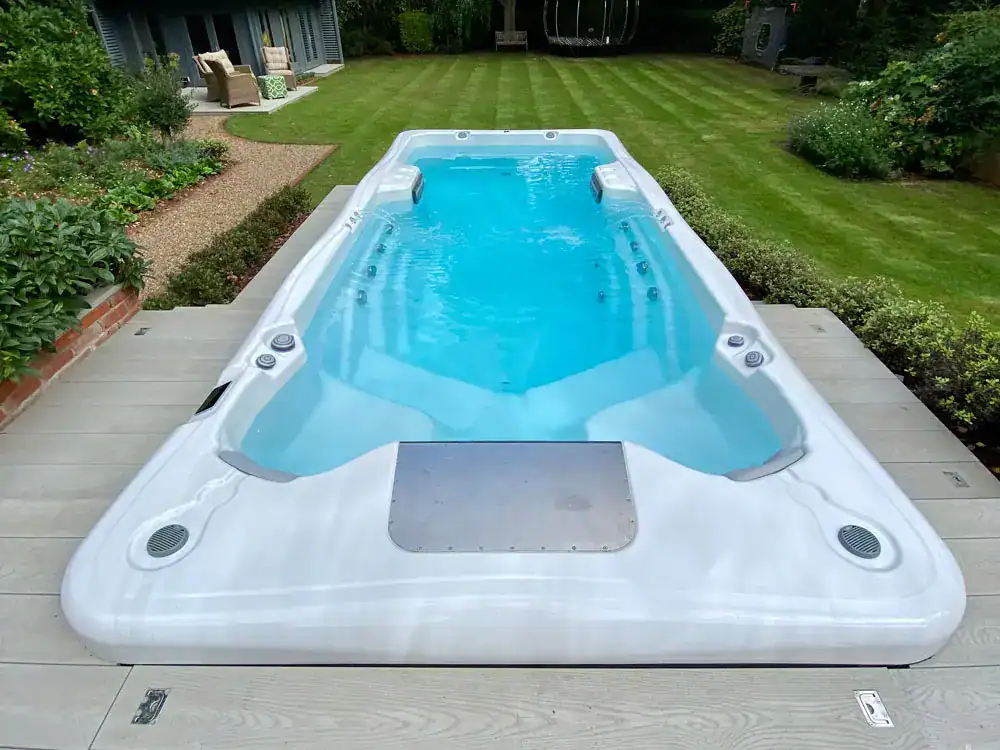
In this guide, we’ll break down the top seven swim spa buyer mistakes we see most often, including:
- The hidden costs that can quietly double your total investment
- Contractor and dealer red flags that signal trouble ahead
- Energy-efficiency details that can mean the difference between a $30 or $200 monthly electric bill
At Epic Swimming Pools in Raleigh, we’ve helped hundreds of homeowners throughout the Triangle make informed swim spa decisions and avoid expensive regrets. Let’s make sure you know what to look out for before you buy.
Key Takeaways
- Total cost matters more than purchase price: A $22,000 “budget” spa can cost $66,100 over 10 years vs. $52,000 for a $32,000 well-insulated model
- Energy costs vary wildly: $15-$200 monthly depending on insulation quality (full foam vs. minimal = $8,640 difference over 10 years)
- Professional installation is non-negotiable: DIY voids warranties and creates expensive problems
- Site prep mistakes cost thousands: Inadequate clearance, poor drainage, and utility strikes add $5,000+ in emergency fixes
- Dealer support outlasts the sale: 55% increase in service calls means you’ll need help; choose dealers with proven support
- Warranties have major gaps: Shell covered 10 years, labor often just 1-2 years, and maintenance records required
Match spa to actual use: Fitness, therapy, or family recreation require different features; wrong choice = regret
Table of Contents
Show
Mistake #1: Focusing Only on Purchase Price (Ignoring Total Cost of Ownership)
The purchase price is actually the smallest part of swim spa ownership. We see $25,000 and think, “I can afford that” without calculating the real 10-year cost. Marketing’s “low monthly payments” trap makes $399/month feel better than $35,000 total, but those payments exclude installation, electrical work, and operating costs that start immediately.
The Real Numbers Behind Total Cost of Ownership
Let’s break down the real cost of a swimming spa, in the short- and long-term.
Initial Costs:
- Swim spa: $15,000-$45,000
- Installation: $800-$7,000 (above-ground vs. in-ground)
- Electrical work: $800-$3,000 (220V circuit, GFCI, wiring)
- Concrete pad: $1,000-$2,500
- Permits: $200-$800
Operating Costs:
- Electricity: $15-$200 monthly (varies by insulation)
- Chemicals: $15-$35 monthly
- Maintenance: $200-$800 yearly
| Expense Category | Well-Insulated Model | Poorly-Insulated Model |
| Purchase price | $32,000 | $22,000 |
| Installation | $4,500 | $4,500 |
| Electricity (10 years) | $4,800 | $24,000 |
| Maintenance (10 years) | $7,200 | $9,600 |
| Repairs | $3,500 | $6,000 |
| TOTAL 10-YEAR | $52,000 | $66,100 |
That $10,000 “savings” on the cheaper model costs you $14,000 more over a decade.
How to Avoid This Mistake
The best way to avoid sticker shock later is to shift your mindset from purchase price to total cost of ownership. That starts with asking better questions before you ever sign a contract.
Get a Fully Itemized Quote
Instead of accepting a single number or a vague “all-in” estimate, ask for a fully itemized quote. Delivery fees, crane rentals, electrical upgrades, concrete pads, permits, and site preparation can add thousands to the final cost, and those details matter. Reputable dealers should be willing and able to break down each line item clearly. If the pricing feels intentionally vague, that’s often a red flag.
Look at Energy Costs
Energy costs are another area where assumptions can quietly derail your budget. Don’t settle for general claims about “high efficiency.” Ask for real kilowatt-hour usage data and monthly operating estimates based on local electricity rates. In the Raleigh area, for example, electricity averages around 12 cents per kilowatt-hour, which makes accurate projections especially important. The more transparent the dealer is about real-world operating costs, the more confident you can be in your long-term budget.
Choose the Right Installation
Insulation deserves just as much scrutiny as the shell or jet system. Full foam insulation versus partial cavity insulation isn’t a minor detail, it can mean the difference of thousands of dollars over the life of your swim spa. In some cases, better insulation can save close to $1,800 per year in energy costs. Over a decade, that adds up fast. Ask to see the insulation during showroom tours and don’t be afraid to ask how it performs in year-round North Carolina conditions.
Calculate Long-Term Costs
Finally, take the time to calculate realistic five- and ten-year ownership costs. Think honestly about how often you’ll use the swim spa. Daily workouts and therapy sessions place very different demands on energy consumption than occasional weekend use. Understanding your actual habits will help you choose features that truly matter and avoid paying for upgrades that don’t move the needle for your lifestyle.
Models like the Wellis Beach Club Premium, for example, are designed with full foam insulation and energy-efficient W-EC circulation pumps to help keep long-term operating costs predictable, without sacrificing performance or comfort. When you look beyond the price tag and focus on the full picture, you’ll make a decision that feels just as good years from now as it does on delivery day.
Mistake #2: Choosing a Swim Spa Before Understanding Your Actual Needs
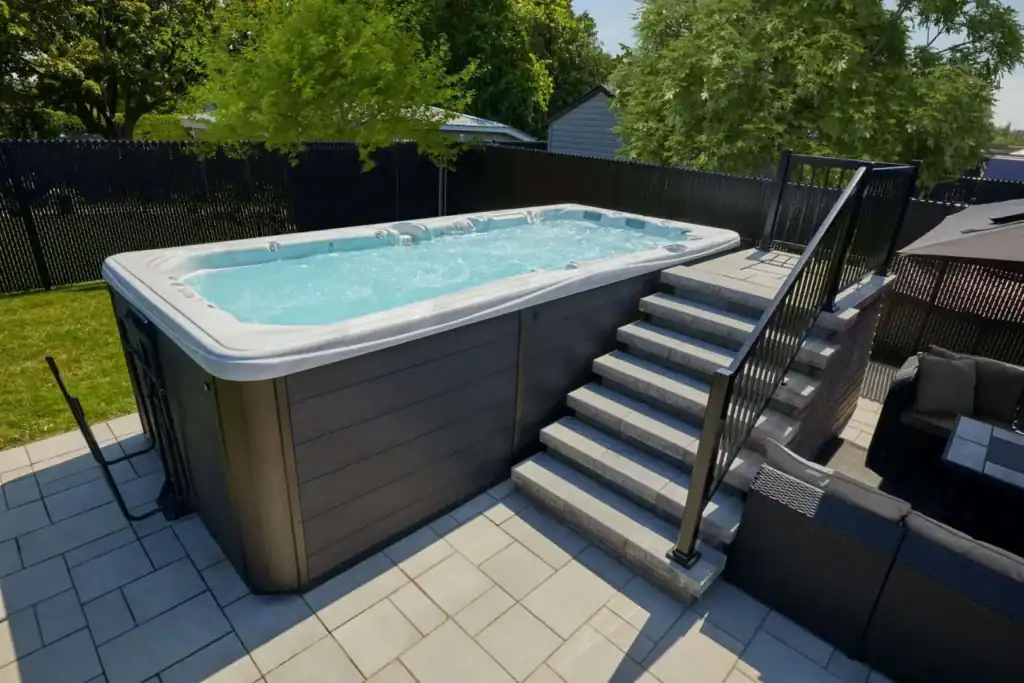
The type of swim spa you choose should come down to exactly what you intend to use it for most, which usually falls into one of three categories:
The Three Primary Use Cases
Swim spas serve three distinct purposes. If you’re planning on using it for:
- Fitness/Athletic Training… You’ll need 3 or more counter-current jets, at least 14 feet of length, and adjustable resistance. Not for casual swimmers.
- Therapy/Relaxation… You’ll need a swim spa that prioritizes hydrotherapy jets, temperature control, and comfortable seating. Swimming is secondary.
- Family Recreation… Look for 4-6 person capacity, balanced jets, and dual-zone temperature. The Wellis Beach Club models excel with two integrated sunbeds for multi-generational use. Trust us, there are reasons why the Wellis Beach Club is becoming so popular among families wanting fitness and recreation balance.
Most buyers choose based on price rather than matching features to actual usage, ending up with the wrong spa for their needs.
Size and Space Planning
For swim spas, bigger isn’t automatically better. In fact, oversizing is one of the easiest ways to drive up long-term ownership costs without gaining any real benefit. Larger swim spas require more water to heat, more chemicals to balance, and more electricity to keep running, expenses that add up every month whether you’re using the extra space or not.
Start by thinking honestly about who will use the swim spa and how they’ll use it. If the primary goal is lap swimming or aquatic fitness, most swimmers under six feet tall don’t need a 19-foot model to get an effective workout. Many mid-sized swim spas provide more than enough swim current and length for consistent training while remaining far more efficient to operate. Extra length often looks impressive in a showroom but rarely translates into better performance at home.
Capacity is another area where buyers tend to overestimate. A good rule of thumb is to plan for your primary users, plus room for about four guests. That covers everyday use and the occasional gathering without paying year after year to maintain space that sits empty most of the time. If entertaining large groups is a priority, that’s worth factoring in, but it should be a conscious decision rather than an assumption.
Just as important as the spa itself is the space around it. Your planning shouldn’t stop at the swim spa’s footprint. You’ll need a minimum of three to four feet of clearance on all sides for maintenance access, cover removal, and service work. This is non-negotiable. Skipping this step can lead to difficult, expensive service calls or force you to relocate the spa entirely.
Questions to Ask Before Shopping
- What’s your primary use? (Pick one: fitness, therapy, or recreation)
- Realistic usage pattern? (Daily, weekly, seasonal)
- Core users? (Size accordingly, not aspirationally)
At Epic Swimming Pools, we start consultations with these questions before discussing models.
Mistake #3: Underestimating Energy Costs and Ignoring Insulation Quality
The Range of Monthly Operating Costs
One of the biggest surprises for new swim spa owners isn’t the purchase price, it’s the electric bill that follows. Monthly operating costs for swim spas can vary dramatically, ranging anywhere from $15 to $200 per month. That difference may not sound alarming at first, but over time it becomes significant. At the low end, you’re looking at roughly $1,800 per year in energy costs. At the high end, that number balloons to $24,000 over a ten-year period, often more than the spa itself originally cost.
So why is the gap so wide? In most cases, it comes down to insulation quality.
Swim spas are essentially large volumes of heated water that must maintain a consistent temperature year-round. Poor insulation allows heat to escape constantly, forcing the heater and circulation pumps to work harder and longer. Even in relatively mild climates, that heat loss adds up quickly. In colder months, the inefficiencies become even more obvious.
In Raleigh, where electricity costs about 12 cents per kWh, a well-insulated swim spa uses about 1,000 kWh monthly in winter (when working hardest). That’s $120 monthly or $1,440 annually. Poorly insulated models? Try 1,600 kWh monthly: $192 monthly or $2,304 annually. The difference: $864 yearly, $8,640 over 10 years.
Insulation Types Explained
Full Foam Insulation
This is widely considered the gold standard in swim spa construction. In this design, every cavity inside the cabinet is filled with expanding foam, completely surrounding the shell and plumbing. This creates a continuous thermal barrier that dramatically reduces heat loss while also supporting the plumbing to minimize vibration and movement. The result is lower energy consumption, quieter operation, and reduced stress on fittings over time. Manufacturers like Wellis use full foam insulation to maximize efficiency and long-term reliability, making it an ideal choice for homeowners who plan to use their swim spa year-round.
Partial Cavity Insulation
Partial Cavity Insulation offers a middle-ground approach. Some areas of the cabinet are insulated, while others are left open or lightly protected. This design improves efficiency compared to budget models but still allows heat to escape through uninsulated gaps. Monthly operating costs typically fall somewhere in the middle range, making partial cavity insulation a reasonable option for buyers trying to balance upfront cost with ongoing efficiency. However, those savings often diminish over time as energy costs accumulate.
Minimal or No Insulation
This type is most commonly found in lower-priced, entry-level swim spas. These models may rely on thin foam panels, reflective barriers, or minimal sprayed insulation. While the initial purchase price may look appealing, the trade-off comes in the form of consistently high energy bills, often $150 to $200 per month, especially during colder months or with frequent use. Over the life of the swim spa, those higher operating costs can far outweigh the upfront savings.
Evaluating Energy Efficiency
Here are some of our favorite tips for evaluating energy efficiency:
- Ask about CEC compliance (California Energy Commission standards). If a spa meets CEC requirements, it’s reasonably efficient. Not every spa sold in North Carolina needs these standards, meaning some dealers sell energy hogs they couldn’t legally sell in California.
- Request BTU heat loss specifications. This measures heat loss per hour. Lower numbers mean better insulation. Anything above 50 BTU/hour per 100 square feet raises concerns.
- Check pump efficiency ratings. Variable-speed pumps use 30-50% less electricity than single-speed pumps. The Wellis W-EC circulation pump delivers low consumption with long service life and quiet operation.
- Inspect cover quality and R-value. Cheap covers with R-12 let heat escape. Quality covers with R-20+ keep operating costs reasonable. Wellis includes their Beach Club Rollcover BlackTex with proper insulation.
- Test temperature retention if possible. Fill the spa, heat to 104°F, check temperature after 24 hours with cover on. Well-insulated spas lose under 2°F. Poorly insulated models drop 8-10°F.
At Epic Swimming Pools, our Wellis Beach Club Premium includes energy-efficient W-EC pumps and full foam insulation to keep costs manageable.
Mistake #4: Skipping Professional Installation (or Hiring the Wrong Contractor)
It’s easy to underestimate what goes into installing a swim spa, especially after spending a significant amount on the unit itself. Some buyers attempt a DIY installation to “save a little money,” while others hire the lowest bidder without verifying experience. Unfortunately, this is one of the fastest ways to turn a great swim spa into an ongoing source of stress, repairs, and unexpected costs.
Why DIY Installation Fails
Swim spas are not plug-and-play products. They require proper site preparation, precise leveling, and safe electrical connections, typically a 220V dedicated electrical circuit, all of which must meet local building and safety codes. Attempting a DIY installation introduces serious risks, from electrical hazards and improper grounding to structural failures caused by uneven or inadequate foundations.
One of the biggest consequences buyers don’t realize until it’s too late is warranty invalidation. Most swim spa manufacturers require installation by licensed professionals to keep warranties intact. Skipping this step can instantly void coverage on major components, including the shell, plumbing, and electrical systems. For example, a 10-year shell warranty, provides tremendous long-term protection, but it becomes essentially worthless if the spa isn’t installed according to manufacturer specifications.
Improper installation also tends to reveal itself slowly. A foundation that isn’t perfectly level can place uneven stress on the shell and plumbing, leading to leaks or cracks months or even years later. Electrical shortcuts may work initially, only to fail inspection or create safety concerns down the line. These problems are rarely inexpensive to fix and often require partial removal or relocation of the swim spa.
Even hiring a contractor isn’t a guarantee unless they have specific swim spa or hot tub experience. General contractors who aren’t familiar with spa requirements may overlook critical details such as load-bearing calculations, access clearances, or proper drainage. That’s why working with experienced professionals coordinated by or recommended through your swim spa dealer is so important.
Red Flags When Choosing Contractors
Be on the lookout for these red flags:
- “We don’t need permits” (every installation requires electrical permits minimum)
- Lowest bid by 30%+ (underestimating work or cutting corners)
- No verifiable references or portfolio
- Vague “all-in” pricing without itemization
- No electrical license (verify with state board)
- No physical location (fly-by-night operations)
What Professional Installation Includes
A truly professional swim spa installation will include:
- Site assessment with measurements and utility identification
- 6-inch reinforced concrete pad (rebar or wire mesh, not 4 inches)
- Licensed electrician: 220V circuit, 50-60 amp, GFCI 5-10 feet away per National Electrical Code
- Proper permits and inspections (electrical minimum, sometimes building permits)
- Crane delivery if access limited ($1,000-$1,500 additional)
- Equipment testing, water chemistry setup, operation training
Real Case Study
A Durham family had their concrete pad ready, spa delivered, excitement building. Their electrician reviewed requirements and said they’d need a $3,000-$4,000 panel upgrade that hadn’t been budgeted. Panic set in.
They called Epic before proceeding. Our assessment showed their 200-amp panel could handle the load fine. The electrician simply wasn’t familiar with swim spa electrical requirements and overestimated demand. A more experienced electrician completed work properly for $1,800 with no panel upgrade.
The lesson? Experience with swim spas specifically matters. General electricians might not understand how swim spas manage electrical load. They see “50-amp requirement” and assume the worst without understanding swim spas don’t run everything simultaneously.
At Epic Swimming Pools, our licensed contractors handle complete installations with transparent 2-week timelines, training on controls, and coordination of all permits and inspections.
Mistake #5: Neglecting Site Preparation and Space Planning
Poor site selection creates expensive problems: uneven ground requiring excavation, inadequate access forcing crane charges, utility conflicts, drainage failures, and clearance violations making service impossible.
Site Requirements Checklist
- Level surface: 0.5% slope maximum
- Reinforced concrete: 4-6 inches thick with rebar, extends 6 inches beyond spa. Similar to in-ground pools foundation requirements.
- Clearance: 3-4 feet all sides (mandatory for maintenance)
- Drainage: Dedicated channels prevent water pooling
- Electrical proximity: Closer to panel = lower wiring costs
- Permits: Verify zoning and HOA restrictions first
| Site Factor | Acceptable | Consequence of Ignoring |
| Surface slope | <0.5% grade | Shell stress, cracking, warranty void |
| Concrete pad | 6″ reinforced | Settling, equipment failure |
| Clearance | 3-4 feet all sides | Service impossible, expensive repairs |
| Drainage | Dedicated channels | Foundation erosion, water damage |
| Utilities | Marked, verified | $5,000+ emergency repairs |
Even the best swim spa can run into problems if the installation site isn’t prepared correctly. Buyers often focus solely on the spa itself and forget that the surrounding environment plays a critical role in both performance and longevity. Small oversights during site planning can lead to expensive corrections, or even make maintenance impossible.
Common Site Mistakes
Ignoring Space on Sides
One of the most frequent errors is measuring only the spa’s footprint while ignoring the additional 3–4 feet of clearance needed on all sides. This space is essential for servicing pumps, accessing plumbing, and removing the cover safely. Without it, simple maintenance tasks can become frustrating or impossible.
Too Close to Obstacles
Placement relative to fences, corners, or other structures is another common oversight. A spa tucked too close to a wall or fence may fit perfectly in your backyard, but it could block access for technicians, cranes, or delivery crews, resulting in delays or costly rework.
Not Prepping a Wood Deck
Wood decks are particularly tricky. A standard swim spa can weigh 18,000 pounds or more when filled with water and users. Installing one on a deck without verified structural support can create a serious hazard. Engineering approval is essential to ensure the deck can handle the load safely.
Sun Exposure
Sun exposure is often overlooked but can affect your spa and operating costs in subtle ways. Constant direct sunlight may increase heating requirements and cause faster wear on the spa cover and cabinetry. Shaded or partially shaded placement can help prolong the life of components and reduce energy bills.
Forgoing Utility Check
Skipping a utility check before digging can be costly and dangerous. Electrical lines, water lines, or gas pipes can be hidden just beneath the surface. Always call 811 to have underground utilities marked before any excavation.
Site Assessment Best Practices
Taking a proactive approach to site preparation saves headaches and money down the road. Start with a professional site survey before purchase, which typically costs $200–$400. Surveyors evaluate grading, drainage, and accessibility, ensuring the site can accommodate your chosen swim spa model.
Underground utilities should always be marked before work begins, this is a free service through 811 in the U.S., and it protects both your property and your safety.
If your swim spa won’t be installed on concrete, consider soil compaction testing to ensure the ground can support the weight of the filled spa without settling. Similarly, evaluate the access pathway carefully, accounting for potential crane costs if your spa must be lifted over structures or uneven terrain.
By addressing these factors upfront, you’ll avoid surprises during delivery, reduce maintenance challenges, and protect your investment for years to come. Proper site preparation isn’t just about convenience, it’s the foundation of a safe, functional, and enjoyable swim spa experience.
Mistake #6: Choosing a Dealer Based on Price Alone (Not Reputation or Support)
The After-Sales Service Reality Nobody Talks About
Buying a swim spa is easy. Anyone can take your money and deliver a spa to your driveway. The real test comes afterward: when you need help balancing water chemistry, when equipment stops working, when you have questions about operation.
Industry data shows a 55% increase in service call volume year-over-year. That tells you something important: most buyers need professional help. This isn’t a “set it and forget it” product.
Most buyers need professional help within their first 90 days. Water chemistry problems, equipment malfunctions, or just confusion about proper operation. If your dealer disappeared after delivery or has no service department, you’re on your own.
Warranty claims require dealer intervention. You can’t call the manufacturer directly for most issues. Your dealer processes warranty claims, coordinates service, and advocates on your behalf. A bad dealer makes this process miserable.
Warning Signs of Unreliable Dealers
I’m going to give you the red flags we’ve identified after years in this industry:
No Physical Showroom or Display Models
Online-only dealers save money on facilities, but you can’t test anything before buying. And when you need in-person support, there’s no “there” there. Buying a swim spa without sitting in it first is like buying a car without a test drive.
Unwilling to Provide Customer References
Legitimate dealers have dozens of happy customers who’ll speak on their behalf. If a dealer can’t give you three recent references, they either have no customers or their customers are unhappy.
Negative Online Reviews Mentioning Service Failures
One or two bad reviews? That happens. But patterns matter. If multiple reviews mention “impossible to reach after purchase” or “warranty claims denied,” believe them.
“Traveling Event Sales” with Temporary Locations
These pop-up sales happen in hotel ballrooms or rented spaces. Professional “closers” work on commission selling as many units as possible. Once the event ends, good luck getting service. The company operates outside their normal territory specifically to sell, not support.
No Manufacturer Certification
Authorized dealers receive training, support, and warranty backing from manufacturers. Unauthorized dealers might sell legitimate products, but they can’t access factory support when you need it.
No In-House Service Department
If the dealer says “we have a partner who handles service,” ask who that partner is and verify they’re responsive. Better yet, choose a dealer with their own service team who knows their products intimately.
What to Verify Before Purchase
- Years in business and track record
- Manufacturer authorization (authorized Wellis dealer = factory support)
- Service capabilities (on-staff technicians, response times)
- Multiple review sources (patterns, not isolated complaints)
- Post-installation support and ongoing guidance
- Warranty claim processing approach
Epic Swimming Pools’ Dealer Advantage
We’re part of the established Epic Hot Tubs family serving North Carolina for years. Learn more about Epic Swimming Pools and our commitment to quality service.
- Physical Raleigh showroom: test Wellis Beach Club display models before buying
- Browse completed projects across the Triangle
- Authorized Wellis dealer with direct factory support
- Comprehensive training on controls, maintenance, water chemistry
- Local support: call 919-443-6663 for ongoing help
When you call three years later, we remember you and have your installation records.
Mistake #7: Misunderstanding Warranties (and What They Don’t Cover)
“Lifetime warranty” means little without reading the fine print. Most buyers see “10-year shell warranty” and assume everything’s covered. While shell structure is covered, equipment maybe just be included for 3-5 years,with labor only covered for 1-2 years.
Multiple manufacturers create warranty fragmentation. Different warranty terms for shell, pump, control system. When something breaks, you’re figuring out which company covers what.
Typical Warranty Structure
| Component | Wellis Beach Club | Common Exclusions | Hidden Issue |
| Shell | 10 years | Discoloration, scratches | Maintenance records required |
| Equipment | 3-5 years (varies) | Wear items | Labor not covered after year 2 |
| Plumbing | 3 years | Freeze/chemical damage | Must prove proper maintenance |
| Cabinet | 1 year | UV damage | Fade = normal wear |
Warranty Voids
Watch out for these common mistakes that can void your swim spa warranty entirely.
- Improper installation (wrong electrical, inadequate foundation)
- Missed maintenance schedules (keep all service receipts)
- Non-approved chemicals (cheap hardware store products)
- DIY repairs (touching internal components)
- Unauthorized modifications (aftermarket parts)
Questions About Coverage
Ask specifically: which components, how many years, labor duration, who performs service, documentation requirements, company bankruptcy protections.
The Wellis warranty includes 10-year shell, 3-year components, 1-year cabinet. At Epic Swimming Pools, we handle manufacturer coordination for warranty claims.
Making a Confident Swim Spa Purchase: Your Action Plan
Pre-Purchase Checklist
- Define primary use case (fitness, therapy, or recreation)
- Calculate 10-year total ownership costs
- Verify site prep requirements and costs
- Research dealer reputation (minimum 3 references)
- Compare energy efficiency specs (insulation type matters)
- Review complete warranty documentation
- Get itemized quotes from 2-3 dealers
Questions for Every Dealer
Ask these specific questions to separate professional dealers from amateurs:
- Total installed cost with all fees? Push for itemized pricing: delivery, crane rental if needed, electrical work, concrete pad, permits, initial chemical kit, cover, steps. Everything.
- Estimated monthly operating costs? Based on your local electricity rates. In Raleigh, that’s about 12 cents per kWh. Ask them to calculate it for the specific model.
- Insulation type and energy specs? Full foam, partial cavity, or minimal? How does it affect operating costs? Can they show you the insulation during a showroom tour?
- Who performs installation? Licensed contractors? Their own team? Subcontractors? Are they insured? Can you verify their credentials?
- Post-installation training and support? Do they walk you through operation? Teach water chemistry basics? Provide documentation? Can you call with questions six months later?
- Can I contact three recent customers? Not testimonials on their website. Actual phone numbers or emails of customers you can contact directly.
- Warranty claim process timeline? How long does it take? Who handles communication with the manufacturer? What do their customers say about warranty support?
These questions reveal whether dealers prioritize long-term customer relationships or quick sales.
Why Raleigh Homeowners Choose Epic Swimming Pools
At Epic Swimming Pools, we understand that purchasing a swim spa is more than a financial investment, it’s an investment in your lifestyle, health, and family time. Raleigh homeowners consistently choose us because we make the entire process straightforward, transparent, and tailored to their needs.
Transparent Total-Cost Pricing
One of the biggest concerns for first-time buyers is hidden costs. That’s why we provide transparent total-cost pricing. Every quote is detailed and itemized, covering delivery, installation, permits, electrical work, and other essential expenses. No surprises, no last-minute add-ons, just a clear understanding of your investment from day one.
Full Foam Insulation
Our swim spas feature the premium Wellis Beach Club line, built with full foam insulation for maximum energy efficiency, reduced operating costs, and year-round comfort. With these energy-efficient systems, you can enjoy your spa without worrying about sky-high monthly bills.
2-Week Installation Turnaround
Time is valuable, and we respect that. Our licensed, experienced teams typically complete installations in just two weeks, so you can start enjoying your swim spa quickly and safely. Every installation is handled by professionals who understand local codes, electrical requirements, and proper site preparation, ensuring your spa performs optimally for years to come.
Licensed and Experienced Teams
But our service doesn’t stop after installation. We provide comprehensive training so you feel confident using your spa from day one, and our team is always available for ongoing local support. If questions arise or maintenance is needed, Raleigh residents can reach us directly at 919-443-6663, ensuring you have expert guidance whenever you need it.
For those who want to see a spa in person before committing, our showroom at 4205 Wake Forest Rd, Suite 200, Raleigh offers a hands-on experience. You can test the layout, explore features, and speak with our knowledgeable staff about which model and setup best fit your backyard, lifestyle, and budget.
The Bottom Line: Informed Decisions Lead to Years of Satisfaction
The seven mistakes cost buyers $10,000-$25,000 in unnecessary expenses over a decade. Despite 21.7% decline in permits, educated buyers still invest successfully by taking time to research and ask hard questions.
Cost Comparison:
- Well-informed purchase: $47,300 total (10 years), high satisfaction
- Mistake-prone purchase: $59,600+ total, ongoing frustration and regret
Proper planning transforms a swim spa from expense into a valued lifestyle investment, with the “cheaper” option costing at least $12,000 more with constant problems. At Epic Swimming Pools, we offer free consultations to help navigate these decisions. Want to calculate ownership costs for your situation? Ready to see Wellis Beach Club models in person? Request pricing or contact our team at 919-443-6663 today!
Frequently Asked Questions
What’s the real difference between a $20,000 swim spa and a $40,000 swim spa?
The primary difference is build quality and insulation, which impacts long-term costs more than upfront price. Cheaper spas use minimal insulation and lower-grade components, resulting in $150-$200 monthly operating costs versus $40-$60 for premium models with full foam insulation. The Wellis Beach Club models include full foam insulation and energy-efficient pumps, typically costing less over 10 years despite higher purchase price. Calculate lifetime costs including electricity ($24,000 vs. $4,800 over 10 years), more frequent repairs on budget models, and shorter lifespan (10-12 years vs. 15-20 years) before making your decision.
How much does it really cost to run a swim spa each month in North Carolina?
In Raleigh-Durham with electricity around 12 cents per kWh, well-insulated swim spas cost $40-$80 monthly total for electricity, chemicals, and maintenance, while poorly insulated models hit $150-$200 monthly. The Wellis Beach Club with full foam insulation and W-EC energy-efficient pumps typically falls on the lower end. Factors affecting cost include usage frequency (daily vs. occasional), ambient temperature, cover quality, and water chemistry maintenance habits. Winter months cost more due to heating demands.
Can I install a swim spa myself to save money?
DIY installation is strongly discouraged because it typically voids your warranty, creates electrical safety hazards with 220V wiring, risks code violations requiring expensive corrections, and causes foundation problems from improper concrete pad construction. Licensed professional installation costs $800-$7,000 depending on complexity but protects your Wellis warranty and ensures proper setup according to manufacturer specifications. Money “saved” on DIY usually gets spent fixing problems within the first year, often totaling more than professional installation would have cost.
How long should a quality swim spa last with proper maintenance?
A well-manufactured swim spa with proper maintenance lasts 15-20 years, with premium acrylic shells like Wellis lasting 20-25 years. Equipment components (pumps, heaters, controls) typically need replacement every 7-12 years depending on usage and maintenance. Budget models with minimal insulation and lower-grade components might only last 10-12 years before requiring major repairs. The Wellis 10-year shell warranty provides strong protection during critical years, and regular professional maintenance significantly extends overall lifespan.
What should I look for in a swim spa dealer beyond price?
Prioritize service and support over purchase price by verifying: physical showroom for testing models, years in business with verifiable customer references (minimum three), manufacturer authorization and training credentials, in-house service department or reliable service partners, transparent warranty claim processing, post-installation training and ongoing support availability, and local presence. Epic Swimming Pools in Raleigh checks all boxes as an established authorized Wellis dealer with comprehensive local support at 919-443-6663, physical showroom access, and decades of combined experience.
Have questions, or want to see options in person? Stop by any of our five North Carolina showrooms and talk it through with our team: Raleigh, Durham, Sanford, Charlotte, or North Charlotte. We are open 7 days a week, no appointment needed.

About The Author:
Richard Horvath
Hot Tub & Spa Expert
Richard has been in the hot tub & spa industry for years. As a long hot tub & swim spa owner himself, Richard has a passion for helping homeowners create their dream backyard.